
A "First-class Cook"
Rikitaro Ushio

Sarah Winchester found herself in need of a cook at her new home in Atherton after the Great San Francisco Earthquake of 1906. Perhaps she saw the newspaper ads that billed 25-year-old Rikitaro Ushio as a “first-class cook.” He had emigrated from Hiroshima to San Francisco in 1905 and later that same year, married Tomo, another new arrival. The 1906 earthquake displaced them from San Francisco, but by 1908 the couple was working for Mrs. Winchester.

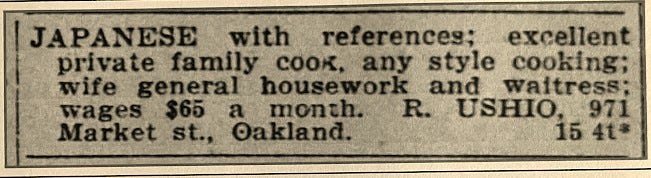
The Ushios joined Winchester’s full-time Atherton household along with two nurses, a chauffeur, another Japanese man in the kitchen, a Chinese gardener, and next door, a Scottish groundskeeper and his wife. Rikitaro took the American name “George,” and managed the kitchen while Tomo worked as a maid and waitress.
It is unclear why the Ushio’s left Winchester’s employ in 1916; perhaps Tomo was ill. She died just two years later.
In 1920, Rikitaro sailed to Japan, married Shizuko Ishida, and returned to San Francisco. The couple had two sons and a daughter during the 1920s. Most of that time he worked as a cook for a private family, but by 1940, he was working in a San Francisco bakery. Rikitaro’s American children were teenagers.
President Franklin Roosevelt’s Executive Order 9066 in 1942 upended their lives. It resulted in the removal and incarceration of anyone on the West coast of Japanese ancestry. The presumption was that these people were potential saboteurs, or in case of an invasion by Japan, might aid the enemy.
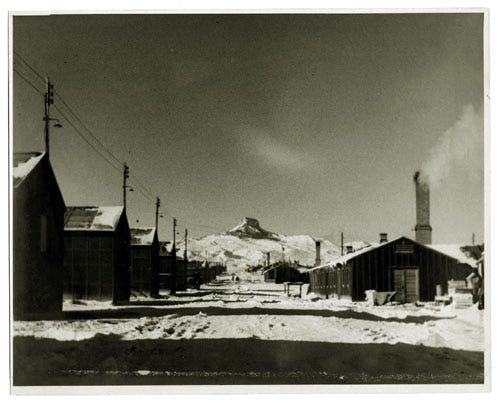
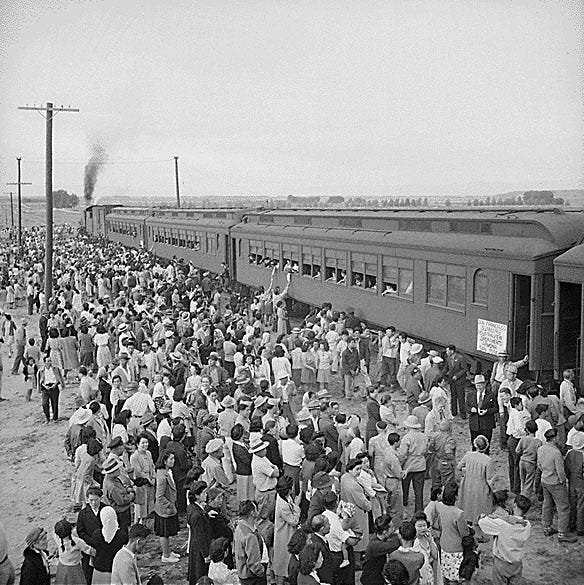
The Ushios, along with thousands of others, most of whom were American citizens and had never been to Japan, were forced from their homes. They lost jobs, not to mention neighbors, pets, schools, and cars. They were loaded onto trains bound for the Los Angeles County Fairgrounds in Pomona. Months later, Rikitaro, his daughter Mitsue, and son Tadasu, found themselves in the Heart Mountain Relocation Center in Wyoming.
But where, I wondered, were Rikitaro’s wife and their eldest son? At first, I thought Shizuko must have died, and Kiyoshi may have joined the Army. They are nowhere to be found in the records—that is, in the US.
I found them in Japan. Somehow they made their way to Japan after the bombing of Pearl Harbor and before the relocations. How they got there what their reasoning was is unknown. And one can only guess what it must have been like to be in the environs of Hiroshima in 1945 when the US dropped an atomic bomb on it and Nagasaki.
Tadasu (Ted), the youngest, was fifteen when he and his family were sent to the Heart Mountain. Losing his mother and brother to Japan, along with camp life, proved too much. On October 17, 1944, Ted was released into the custody of Mendocino State Asylum for the Insane in California, an institution notorious for cruelty and medical experimentation. He remained there until December 8, 1946, over a year after his father and sister had been released from Heart Mountain.
Rikitaro and his daughter, Mitsue, were released in October of 1945, and they made their way to Los Angeles. There must have been nothing for them in San Francisco. Ted was released from the insane asylum late in 1946 and joined them early in 1947. In the 1950s, Rikitaro became a naturalized US citizen. Then he left the US. He joined his wife and older son in Japan where he spent the final six years of his life.
Sarah Winchester’s ‘first-rate’ cook, Rikitaro “George” Ushio, died in 1960 at age 81 in a village outside of Hiroshima very near where he was born. In a sad irony, the American Foreign Service issued a death record for him because it was required for the death of a US citizen abroad. At the end, he was finally recognized as an American.
BTW, Mitsue remained in Los Angeles, but Ted went on to settle in San Mateo County, not far from where his father had cooked for Mrs. Winchester. There’s no telling the scars they bore from the acts of the government, years of incarceration, and being committed to a psychiatric hospital known for murderous quackery. One thing is certain—any economic gains their father made over forty years from work at Winchester’s home or in San Francisco were wiped out. After World War II, The American children of Rikitaro Ushio had to start over with nothing.
That is absolutely heartbreaking. That they were able to survive at all, much less find and maintain contact with each other, is amazing, and testament to their tenacity.
Amazing story.....I wonder what their kids are doing today.
A sad chapter in American history for sure.